
Timeline 1: The Divine Assembly

The information presented in this book is speculative in nature and is not intended to be taken as established historical or theological fact. The theories and interpretations explored here are drawn from ancient Hebrew and biblical texts, including canonical scripture, apocryphal and pseudepigraphal writings, and the Dead Sea Scrolls, as well as ancient Greek literature and other historical texts from cultures around the world that share remarkably similar stories and traditions. Where these sources converge, I have attempted to explore what those connections might suggest, while acknowledging that much remains open to debate and interpretation. Readers are encouraged to approach this material with an open and discerning mind, and to conduct their own research into the primary sources referenced throughout.
In the primordial depths before time held meaning, there existed a gathering of extraordinary beings who inhabited realms beyond mortal comprehension. These entities, known variously as the Council of Gods or the Watchers, comprised the divine assembly responsible for shaping the very foundations of creation itself. Their purpose transcended simple existence, for they were the architects of reality, the builders of worlds, and the formulators of natural law.
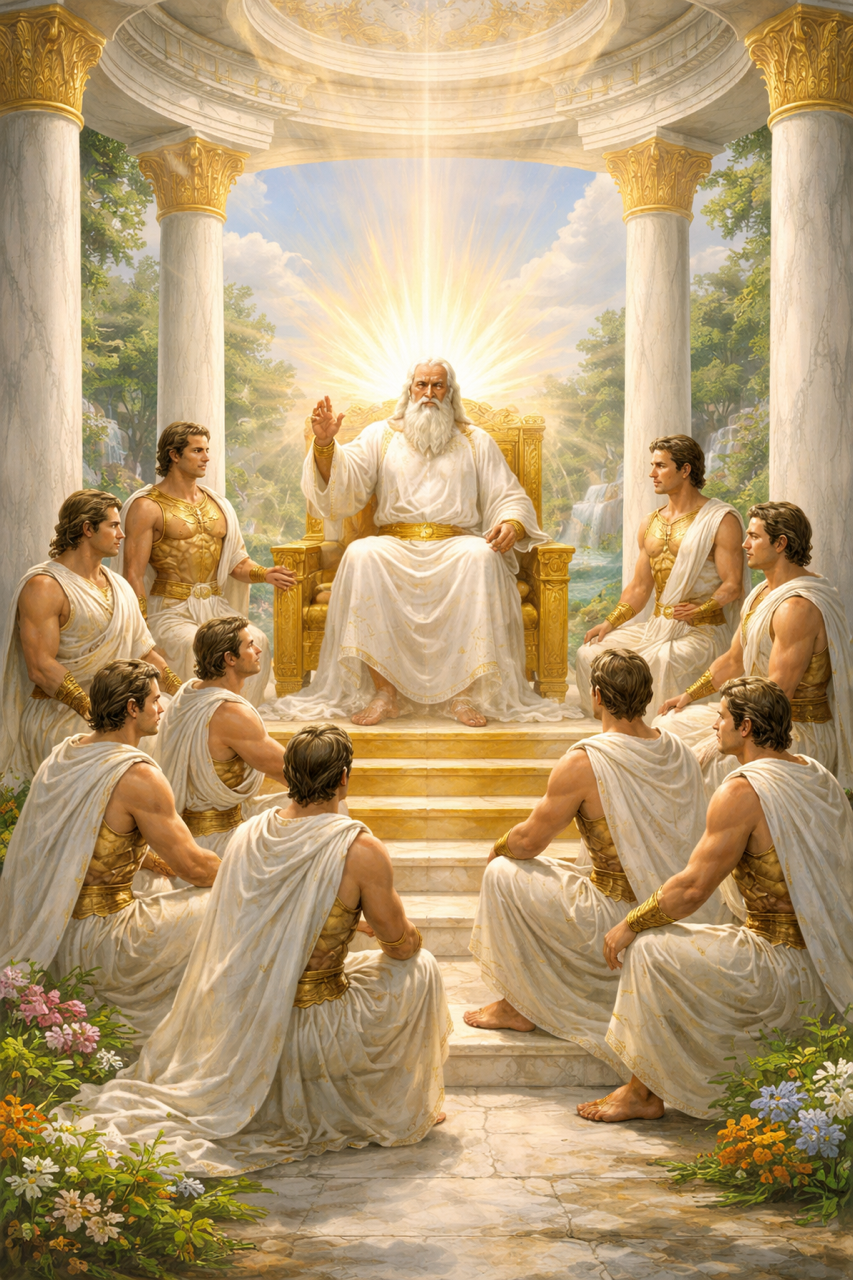
This celestial council represented neither pure benevolence nor absolute malevolence. Instead, it embodied the fundamental duality that would eventually permeate all of creation. Among their ranks stood beings of immense wisdom and creative power, entities devoted to order, harmony, and the establishment of life. Yet alongside these constructive forces gathered those of a different nature, beings whose purposes would introduce chaos, conflict, and discord into the emerging world.
The assembly functioned as a collaborative body, though the term "collaboration" perhaps fails to capture the complexity of their interactions. Each member possessed distinct spheres of influence and specific responsibilities within the grand design. Some oversaw the formation of physical matter, coaxing substance from void and giving form to the formless. Others directed the establishment of natural principles, determining how light would behave, how waters would flow, and how the firmament would hold.
The council met in spaces that existed outside conventional dimensions. These gathering places occupied no fixed location that mortal minds could comprehend, yet they were as real as the earth these beings would eventually fashion. Within these ethereal chambers, the Watchers deliberated over the grand architecture of creation, debating and deciding the fundamental structures that would govern existence.
Some ancient texts preserve fragmentary memories of these deliberations. The Hebrew scriptures speak of divine beings who witnessed the laying of earth's foundations, shouting for joy as the morning stars sang together. This poetic description hints at the magnificent spectacle of creation in progress, with the Watchers present as both observers and participants in the unfolding cosmic drama.
The composition of this divine assembly reflected a hierarchical structure, though not one based on power alone. Different beings held authority over different domains. Some governed celestial mechanics, ensuring the proper movements of heavenly bodies. Others supervised the establishment of temporal cycles, creating the rhythm of days, seasons, and years that would eventually regulate mortal life.
Among the council existed a figure of supreme authority, one who held dominion over the assembly itself. Various traditions identify this being differently. Some call him El Elyon, the Most High. Others know him as Yahweh, the God of Israel. Still others reference him through different names and titles, each culture preserving its own understanding of this ultimate divine power.
This supreme being did not rule through tyranny but through acknowledged supremacy. The other members of the council recognized his authority, though this recognition did not eliminate tension or disagreement within the assembly. The divine beings possessed individual wills and could choose their own courses of action, even when those choices conflicted with the intentions of the Most High.
The benevolent members of the council pursued aims aligned with creation's fundamental purpose. They worked to establish systems that would support life, maintain balance, and allow for growth and development. These beings understood their role as stewards and cultivators, responsible for nurturing the emerging creation into its fullest potential.
Yet even among these benevolent entities, different perspectives existed. Some favored strict order and unchanging perfection. Others advocated for dynamic systems that could adapt and evolve. These differences occasionally led to disagreements within the council, debates about how best to fulfill their creative mandate.
The malevolent members presented a different challenge altogether. Their opposition did not necessarily stem from inherent evil but from alternative visions of what creation should become. Some questioned the wisdom of creating beings with free will. Others doubted the value of physical existence itself. Still others harbored ambitions that placed their own desires above the collective purpose of the assembly.
These divergent viewpoints created friction within the council. The tensions that existed among the divine beings would eventually manifest in the physical creation they shaped, introducing elements of conflict and struggle into the world. The presence of both constructive and destructive forces within the assembly ensured that creation itself would reflect this fundamental tension.
The Watchers engaged in their creative work through means that transcended physical manipulation. They spoke, and their words carried creative power. They willed, and reality conformed to their intentions. They designed, and the universe took shape according to their plans. This process was neither instantaneous nor effortless. Even divine beings labored over their creation, refining and perfecting their work.
As the earth began to take form under their guidance, the council established boundaries and limitations. They defined where land would end and sea would begin. They determined the heights of mountains and the depths of oceans. They set the courses of rivers and designated the locations where life would eventually flourish.
Some members of the assembly took particular interest in specific aspects of creation. Certain Watchers devoted themselves to the formation of celestial bodies, crafting stars and planets with meticulous care. Others focused on atmospheric systems, establishing weather patterns and seasonal cycles. Still others worked on geological structures, building the foundations that would support the weight of mountains and valleys.
The council also debated the nature of life itself. What forms should living beings take? How should they function? What purposes should they serve? These questions generated extensive deliberation within the assembly. The answers they arrived at would determine the character of all subsequent creation.
During this formative period, the benevolent and malevolent factions within the council maintained an uneasy balance. Neither side possessed sufficient advantage to override the other completely. This equilibrium allowed creation to proceed, though it also ensured that the emerging world would contain elements reflecting both perspectives.
The Watchers understood that their creative work carried profound implications. The world they shaped would not remain empty. It was destined to support life, including beings capable of consciousness and choice. This prospect influenced their deliberations significantly. How would these future inhabitants relate to their divine creators? What responsibilities would the Watchers bear toward those who would eventually populate the earth?
Some members of the council viewed the prospect of conscious life with enthusiasm. They anticipated the opportunity to guide and teach, to share wisdom and knowledge with beings capable of receiving it. They imagined a harmonious relationship between the divine and mortal realms, with the Watchers serving as beneficent overseers and the created beings living in grateful acknowledgment of their makers.
Others within the assembly harbored different expectations. Some foresaw conflict and disappointment. They predicted that conscious beings would prove ungrateful, rebellious, and ultimately destructive. These pessimistic voices cautioned against investing too much creative energy in beings likely to squander the gifts they received.
A third group within the council entertained more self serving visions. They recognized in the prospect of conscious life an opportunity for worship and veneration. These beings anticipated receiving honor and glory from the creatures they helped create. Some even contemplated the possibility of more direct involvement in mortal affairs, perhaps dwelling among the beings they had brought into existence.
These varying perspectives shaped the council's approach to creation. The final design of the earth and its systems reflected compromise and negotiation among the different factions. Elements favored by the benevolent members coexisted alongside features championed by those with different intentions. The result was a world of magnificent complexity and inherent tension.
As the creative work progressed, patterns emerged that would characterize the entire created order. Light and darkness alternated in regular cycles. Land and water existed in careful balance. The systems established by the Watchers demonstrated both stability and dynamism, capable of maintaining themselves while also allowing for change and variation.
The council's creative acts established not only physical structures but also spiritual principles. They embedded into creation itself fundamental truths about existence, purpose, and meaning. These principles would guide and constrain all subsequent developments, serving as the foundation upon which the entire cosmic edifice would rest.
Some traditions preserve memories of this period as a golden age, a time when divine beings worked in relative harmony despite their differences. The earth that emerged from their efforts possessed pristine beauty and perfect functionality. Every system operated according to its design. Every structure fulfilled its intended purpose. The world crafted by the council of gods represented creation in its ideal state.
Yet even in this early stage, the seeds of future conflict lay dormant within the divine assembly. The tensions between benevolent and malevolent factions would not remain contained forever. The different visions held by various council members would eventually manifest in more overt opposition. The unity that allowed creation to proceed would fracture under the weight of competing ambitions and conflicting purposes.
The Watchers themselves did not yet comprehend the full implications of their creative work. They could not foresee all the consequences that would flow from the world they shaped. The systems they established with such care would eventually produce results that surprised even their divine architects. Creation possessed an inherent tendency toward complexity and unpredictability that even the council could not entirely control.
As the earth took form, the divine assembly stood at a crossroads. The foundation had been laid. The basic structures existed. The stage was set for the next phase of the creative drama. What would come next would depend partly on the council's continued deliberations and partly on the inherent properties of the world they had brought into being.
The benevolent members of the assembly looked upon their work with satisfaction. They saw a world prepared to receive life, ready to support consciousness, and capable of producing beauty and wonder. They anticipated the fulfillment of creation's purpose with joy and expectation.
The malevolent faction viewed the same creation through different eyes. They saw a world full of potential for exploitation and manipulation. They recognized opportunities to advance their own interests and pursue their own agendas. They contemplated the coming addition of conscious life with calculation rather than celebration.
Between these extremes stood those Watchers whose perspectives remained more complex and ambiguous. They recognized both the promise and the peril inherent in what they had created. They understood that the world they shaped could become either paradise or prison, depending on choices yet to be made by both divine and mortal beings.
The council of gods had completed the first phase of their creative mandate. The earth existed, shaped by divine hands according to a design that reflected both unity and division within the assembly. The foundations were solid. The systems were functioning. The world awaited its next transformation.
Biblical Support for the Divine Assembly
The concept of a divine council or assembly of divine beings appears throughout the Hebrew Bible, though it often remains overlooked in modern readings. Here are the key scriptural passages that support this understanding:
Primary Texts
Psalm 82:1
"God has taken his place in the divine council; in the midst of the gods he holds judgment."
This passage explicitly depicts God standing within an assembly of divine beings (elohim) and pronouncing judgment upon them.
Psalm 89:5-7
"Let the heavens praise your wonders, O LORD, your faithfulness in the assembly of the holy ones. For who in the skies can be compared to the LORD? Who among the heavenly beings is like the LORD, a God feared in the council of the holy ones, great and awesome above all who are around him?"
This text refers to the "assembly of the holy ones" and the "council" where God presides.
Job 1:6 and 2:1
"Now there was a day when the sons of God came to present themselves before the LORD, and Satan also came among them."
This passage describes a formal gathering where the "sons of God" (bene elohim) present themselves before Yahweh.
Job 38:7
"When the morning stars sang together and all the sons of God shouted for joy?"
God reminds Job that the divine beings witnessed creation itself.
1 Kings 22:19-22
"I saw the LORD sitting on his throne, and all the host of heaven standing beside him on his right hand and on his left; and the LORD said, 'Who will entice Ahab, that he may go up and fall at Ramoth-gilead?' And one said one thing, and another said another. Then a spirit came forward and stood before the LORD, saying, 'I will entice him.'"
This vision depicts a divine council meeting where different members offer suggestions and one is chosen to execute God's will.
Deuteronomy 32:8-9 (ESV)
"When the Most High gave to the nations their inheritance, when he divided mankind, he fixed the borders of the peoples according to the number of the sons of God. But the LORD's portion is his people, Jacob his allotted heritage."
This crucial passage indicates that God divided the nations and assigned them to members of the divine council, while retaining Israel for himself.
Daniel 4:17
"The sentence is by the decree of the watchers, the decision by the word of the holy ones, to the end that the living may know that the Most High rules the kingdom of men and gives it to whom he will and sets over it the lowest of men."
Here, the "watchers" and "holy ones" participate in divine decisions affecting earthly kingdoms.
Daniel 7:9-10
"As I looked, thrones were placed, and the Ancient of Days took his seat; his clothing was white as snow, and the hair of his head like pure wool; his throne was fiery flames; its wheels were burning fire. A river of fire issued and came out from before him; a thousand thousands served him, and ten thousand times ten thousand stood before him; the court sat in judgment, and the books were opened."
This vision depicts a heavenly court scene with multiple thrones and countless divine servants.
Genesis 1:26
"Then God said, 'Let us make man in our image, after our likeness.'"
The plural pronouns have traditionally been interpreted as either the royal "we," the Trinity, or God addressing the divine council.
Genesis 3:22
"Then the LORD God said, 'Behold, the man has become like one of us in knowing good and evil.'"
Again, the plural pronoun suggests God speaking within a divine assembly.
Genesis 11:7
"Come, let us go down and there confuse their language, so that they may not understand one another's speech."
At Babel, God again uses plural pronouns suggesting counsel with other divine beings.
Isaiah 6:1-8
"In the year that King Uzziah died I saw the Lord sitting upon a throne, high and lifted up; and the train of his robe filled the temple. Above him stood the seraphim... And I heard the voice of the Lord saying, 'Whom shall I send, and who will go for us?'"
Isaiah's vision depicts the divine throne room with attendant beings, and God's question uses both singular and plural.
Psalm 29:1
"Ascribe to the LORD, O heavenly beings, ascribe to the LORD glory and strength."
The "heavenly beings" (literally "sons of God/gods") are called to worship.
Psalm 95:3
"For the LORD is a great God, and a great King above all gods."
This acknowledges other divine beings while asserting Yahweh's supremacy over them.
Psalm 97:7
"All worshipers of images are put to shame, who make their boast in worthless idols; worship him, all you gods!"
Even the divine beings are commanded to worship Yahweh.
Deuteronomy 4:19-20
"And beware lest you raise your eyes to heaven, and when you see the sun and the moon and the stars, all the host of heaven, you be drawn away and bow down to them and serve them, things that the LORD your God has allotted to all the peoples under the whole heaven. But the LORD has taken you and brought you out of the iron furnace, out of Egypt, to be a people of his own inheritance, as you are this day."
This passage indicates that God "allotted" the host of heaven to other nations while claiming Israel for himself.
Exodus 15:11
"Who is like you, O LORD, among the gods? Who is like you, majestic in holiness, awesome in glorious deeds, doing wonders?"
This rhetorical question acknowledges the existence of other divine beings while asserting Yahweh's incomparability.
New Testament References
Ephesians 6:12
"For we do not wrestle against flesh and blood, but against the rulers, against the authorities, against the cosmic powers over this present darkness, against the spiritual forces of evil in the heavenly places."
Paul acknowledges a hierarchy of spiritual powers and authorities.
Colossians 1:16
"For by him all things were created, in heaven and on earth, visible and invisible, whether thrones or dominions or rulers or authorities, all things were created through him and for him."
This indicates various ranks of spiritual beings, all created by Christ.
1 Corinthians 8:5-6
"For although there may be so-called gods in heaven or on earth, as indeed there are many 'gods' and many 'lords', yet for us there is one God, the Father, from whom are all things and for whom we exist, and one Lord, Jesus Christ, through whom are all things and through whom we exist."
Paul acknowledges the existence of other spiritual beings called "gods" while maintaining monotheistic devotion.
These passages collectively demonstrate that the biblical authors understood God to preside over a council of divine beings, though He remained supreme and unique among them. This divine assembly witnessed creation, participated in heavenly deliberations, and had various roles assigned to them in God's governance of creation.
Author Melissa Saulnier

Comments