
Timeline 2: Eden as Divine Sanctuary

The information presented in this book is speculative in nature and is not intended to be taken as established historical or theological fact. The theories and interpretations explored here are drawn from ancient Hebrew and biblical texts, including canonical scripture, apocryphal and pseudepigraphal writings, and the Dead Sea Scrolls, as well as ancient Greek literature and other historical texts from cultures around the world that share remarkably similar stories and traditions. Where these sources converge, I have attempted to explore what those connections might suggest, while acknowledging that much remains open to debate and interpretation. Readers are encouraged to approach this material with an open and discerning mind, and to conduct their own research into the primary sources referenced throughout.
After the great catastrophe that reshaped the earth, the world that emerged from the receding waters bore little resemblance to what had existed before. Mountains stood where valleys once lay. Seas covered lands that had known the footsteps of countless generations. The face of the entire planet had been transformed by judgment and renewal. Yet amid this transformed creation, one place stood apart as a realm of perfect order and divine presence.
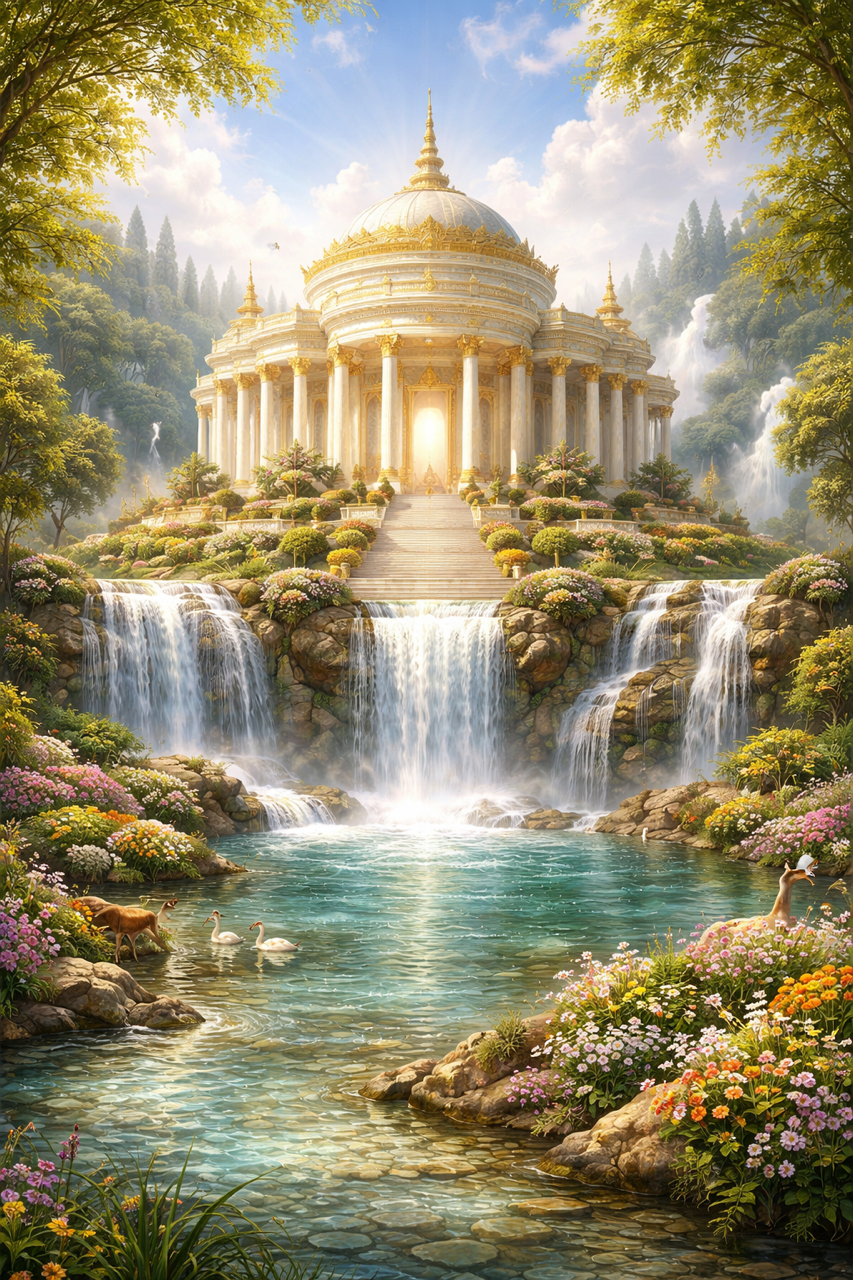
The Garden of Eden represented more than simply a pleasant habitat for the first human beings. Ancient texts suggest that this location served as a sanctuary where the divine and earthly realms intersected. Here, in this carefully bounded space, Yahweh himself dwelt in intimate proximity with his creation. The garden was not merely a home for Adam and Eve but a sacred precinct where heaven touched earth.
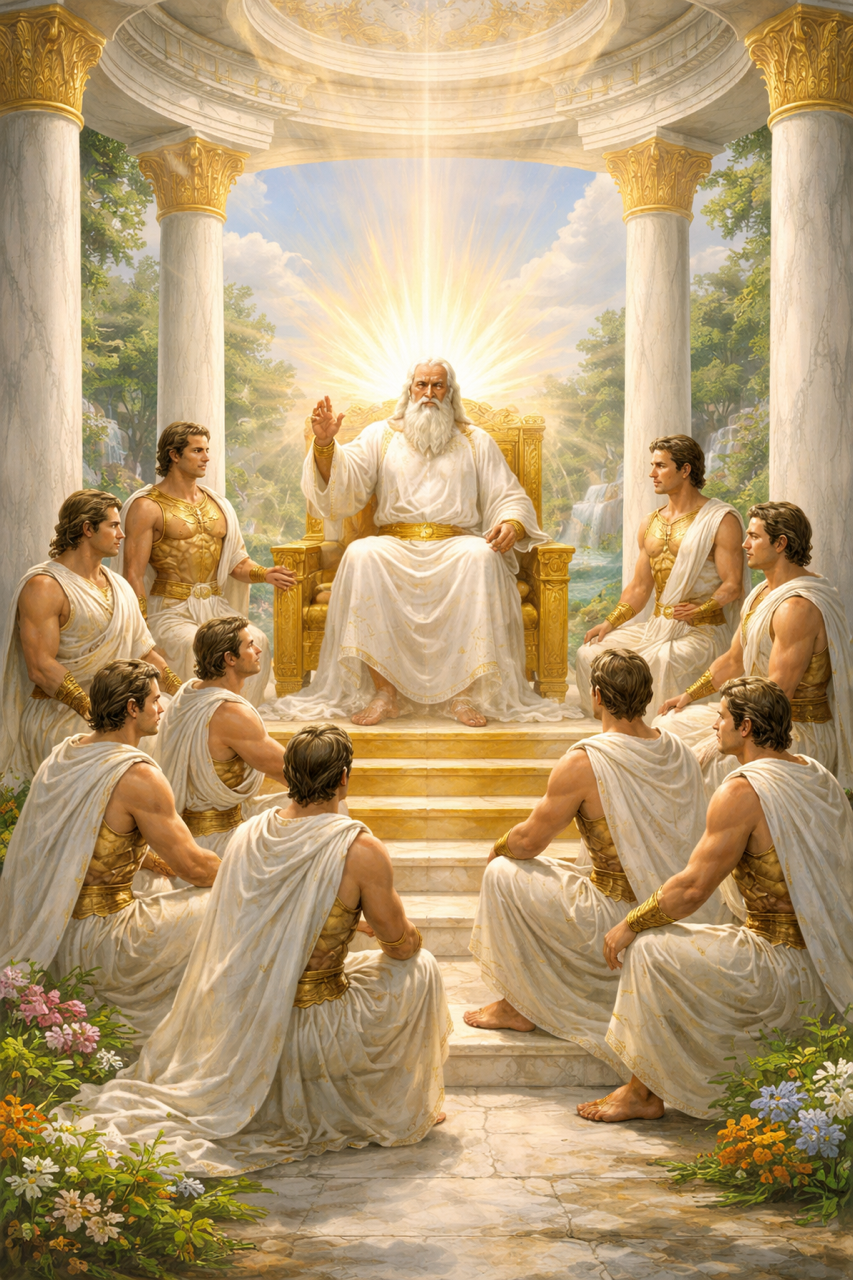
Traditional readings of Genesis often portray Eden as a simple agricultural paradise designed exclusively for human habitation. However, a closer examination of the text reveals layers of meaning that suggest a far more complex reality. The garden functioned as a temple, a throne room, and a meeting place where divine beings gathered in the presence of the Most High.
The very language used to describe Eden in Hebrew scripture contains technical terms associated with sacred spaces and divine dwelling places. The garden was planted "eastward in Eden," a directional indicator that carries theological significance throughout biblical literature. The east represented the direction of divine approach, the place from which God's presence emanated. Temples in Israel would later orient themselves eastward for this very reason.
Within this sacred space, Yahweh walked in the garden during the cool of the day. This description suggests regular divine presence rather than occasional visitation. The garden served as a place where God chose to manifest himself in ways accessible to both human and divine inhabitants. His presence was not abstract or distant but immediate and tangible.
The text hints that Adam and Eve were not the only beings dwelling within Eden's boundaries. When God speaks in Genesis, he often uses plural pronouns that suggest consultation with others. "Let us make man in our image, after our likeness," he declares before creating humanity. Later, after the fall, he observes, "Behold, the man has become like one of us in knowing good and evil." These plural references indicate the presence of other divine beings participating in or witnessing the events unfolding in the garden.
These divine beings, sometimes called the sons of God or the Watchers in various ancient texts, comprised the heavenly council that had existed since before creation. Though the catastrophe had limited their direct interaction with the broader earth, within Eden's sacred boundaries they retained access and presence. The garden served as a meeting point, a place where the barriers between heaven and earth remained permeable.
The cherubim, those mighty angelic beings who would later guard the entrance to Eden after humanity's expulsion, were already present within the garden. They served as guardians and attendants, maintaining the sanctity of this holy space. Their presence indicates that Eden functioned as more than a simple agricultural plot. It was a fortress of divine holiness, a preserved fragment of the perfect order that had characterized creation before corruption entered the world.
Jewish mystical traditions preserve memories of Eden as a multilayered reality. The garden visible to human eyes represented only the outer court of a more extensive divine sanctuary. Beyond what Adam and Eve could perceive lay deeper dimensions where the heavenly council assembled and where the glory of God dwelt in its fullness. The first humans inhabited the threshold of this greater reality, positioned between the purely physical and the purely spiritual.
The trees planted within the garden served purposes beyond providing food and shade. Two trees in particular possessed significance that transcended natural function. The Tree of Life offered immortality to those who ate its fruit, sustaining the eternal existence that God intended for his image bearers. The Tree of the Knowledge of Good and Evil represented moral awareness and the capacity to judge between right and wrong, a prerogative that belonged properly to God alone.
These trees marked Eden as a place where eternal and temporal realities coexisted. Their presence indicated that within the garden's boundaries, the limitations imposed on the rest of the transformed post-catastrophe earth did not fully apply. Here, immortality remained accessible. Here, divine knowledge could be obtained. The garden preserved elements of the pre-fall order that had been lost everywhere else.
The rivers flowing from Eden provide another clue to its unique nature. Four rivers are named as proceeding from a single source within the garden. These rivers then spread outward to water the entire known world. This imagery suggests that Eden occupied a cosmologically central position, a high place from which blessing and life flowed to all surrounding regions.
Some ancient interpreters understood Eden to be located on a cosmic mountain, the axis mundi where heaven and earth joined. From this elevated position, the garden's rivers descended to bring fertility and abundance to the lands below. This geographical symbolism reinforced Eden's role as the point of connection between divine and earthly realms.
Within this sacred space, Yahweh assigned Adam a priestly role. The man was placed in the garden to work it and keep it, language that elsewhere in Hebrew scripture describes the duties of priests serving in the temple. Adam's responsibility was not merely agricultural but spiritual. He served as the human representative maintaining the holiness of God's earthly sanctuary.
Eve's creation from Adam's side occurred within this sacred context. She was fashioned not in some random location but within the garden itself, under the watchful eyes of the divine council. Her formation represented another act of divine creativity performed in the presence of heavenly witnesses. Together, the first human pair embodied the divine image within this realm where heaven and earth intersected.
The divine council's presence in Eden meant that Adam and Eve lived in close proximity to beings of vastly greater power and knowledge. These divine entities, though subordinate to Yahweh, possessed capabilities and understanding far exceeding anything merely human. Their presence in the garden created an environment charged with supernatural awareness and possibility.
Ancient traditions suggest that these divine beings served various functions within Eden. Some acted as instructors, teaching the first humans about the world they inhabited and their responsibilities within it. Others served as guardians, maintaining the boundaries that separated the sacred garden from the less ordered world beyond. Still others functioned as worshipers, praising God in the sanctuary where his presence dwelt.
The serpent that appears in Genesis represents one of these divine beings who had access to Eden. The creature's ability to speak and reason demonstrates intelligence beyond any natural animal. Its knowledge of God's command regarding the forbidden tree indicates familiarity with divine decrees. Most significantly, its presence within the garden shows that not all members of the divine council remained loyal to Yahweh's purposes.
This rebellious entity's access to Eden and to the first humans reveals the complex dynamics at play within the garden. The sanctuary was not sealed against all potential threats. The divine beings present there possessed the freedom to choose their own courses of action, just as humanity would soon exercise similar freedom. The garden's holiness did not eliminate the possibility of rebellion and fall.
The vegetation of Eden exceeded in abundance and beauty anything found elsewhere on the transformed earth. Every tree pleasant to the sight and good for food grew there. The garden represented creation in its ideal state, unmarred by the thorns and thistles that would characterize agriculture after the fall. Within its boundaries, the earth brought forth its increase effortlessly, requiring only light cultivation to maintain optimal productivity.
Gold and precious stones mentioned in connection with Eden indicate that the garden contained treasures of extraordinary value. These resources were not hidden but readily available, suggesting an economy fundamentally different from the scarcity that would characterize human existence after expulsion. Within Eden's borders, abundance prevailed. Need and want had no place in this divine sanctuary.
The presence of these valuable materials also reinforces Eden's identity as a sacred space. Gold and precious stones would later adorn the tabernacle and temple, the structures Israel built to house God's presence among them. Eden was the original temple, and its furnishing with such treasures marked it as the dwelling place of the divine king.
Time itself may have functioned differently within Eden's sacred boundaries. The immortality offered by the Tree of Life suggests that aging and decay did not operate as they would in the broader world. The first humans could potentially have lived forever within the garden, sustained by its fruit and by proximity to the divine presence that permeated the space.
Some interpreters understand Eden as existing partially outside normal temporal flow. As a meeting point between eternal and temporal realities, the garden may have participated in both. Events occurring there had significance not just in historical time but in the timeless realm of divine purpose and cosmic meaning.
The other created beings dwelling in Eden beyond Adam and Eve remain mostly unnamed in the biblical text. Yet their presence is implied by various clues scattered throughout the narrative. The ease with which the serpent approached Eve suggests that encounters with speaking, reasoning beings were not unusual in the garden. The plural pronouns God uses indicate an audience beyond the human pair.
Later biblical books preserve fragmentary references to divine beings who witnessed creation and the establishment of order. The book of Job speaks of the sons of God shouting for joy when the foundations of the earth were laid. These same beings likely maintained presence in Eden, observing the unfolding drama of human origins and early existence.
The garden's location "eastward in Eden" suggests that Eden itself was a larger region, with the garden forming only a portion of it. This broader Eden may have housed other beings and other dimensions of reality not directly accessible to Adam and Eve in their initial state. The garden proper represented the zone where humans were permitted to dwell, but it existed within a larger context of divine activity and presence.
Some ancient Jewish texts describe multiple levels or chambers within Eden, with only the outermost accessible to humanity. The inner sanctums remained the exclusive domain of angels and the divine presence itself. This architecture mirrors the later design of the tabernacle and temple, with courts of ascending holiness leading ultimately to the Holy of Holies where God's presence dwelt most intensely.
The animals present in Eden also bore marks of its sacred character. They displayed no fear of humans and no hostility toward each other. The violence and predation that would characterize nature after the fall had no place within the garden's boundaries. Peace prevailed among all creatures, reflecting the harmony that existed when divine presence permeated creation.
Adam's task of naming the animals indicates a relationship of authority but also intimacy and understanding. The names he assigned were not arbitrary labels but expressions of each creature's essential nature and purpose. This naming represented an act of priestly classification, organizing creation according to divine order.
The divine council's presence in Eden meant that worship occurred there in its purest form. The praise offered to Yahweh by angelic beings combined with the grateful acknowledgment of his goodness by the human creatures he had fashioned. Heaven and earth joined their voices in the garden, creating a harmony that reflected the unity of purpose that should have characterized all creation.
This worship was not formal or ritualistic in the way later temple worship would become. It flowed naturally from the recognition of God's character and the experience of his presence. In Eden, worship was as natural as breathing, as spontaneous as laughter, as constant as the rivers flowing from the garden's heart.
The light that filled Eden may have derived from sources beyond the sun. Some interpreters suggest that the glory of God's presence provided illumination that made ordinary daylight unnecessary. This understanding finds support in later prophetic visions of the new creation, where the city of God needs neither sun nor moon because the glory of the Lord lights it.
The boundaries of Eden were real and maintained. While the garden was not surrounded by impenetrable walls, clear demarcations separated its sacred space from the untamed world beyond. These boundaries protected not just the garden's inhabitants but the garden's holiness. They prevented the disorder and corruption present in the wider world from infiltrating this sanctuary of divine presence.
The placement of Eden on the transformed earth carried theological significance. After the catastrophe had reshaped creation, God established this sanctuary as a sign that redemption and renewal remained possible. Though judgment had fallen and the world had changed, Eden demonstrated that God's original intentions for creation had not been abandoned. The garden stood as a promise and a pattern of what could be restored.
The divine beings present in Eden understood their privilege. They witnessed the creation of humanity and observed the early development of God's image bearers. They saw the intimacy between Creator and creatures, the daily walks in the cool of the day, the assignment of responsibilities, the formation of the first woman. Their presence as witnesses gave cosmic significance to events that involved just two human individuals.
These heavenly observers also understood the danger present within the garden. They knew of the serpent's rebellion and its intention to corrupt humanity. Yet they did not intervene to prevent the approaching catastrophe. The freedom given to both divine and human beings meant that choices would be made and consequences would follow. The garden's holiness did not eliminate the reality of moral decision and its outcomes.
The fellowship that existed in Eden among God, divine beings, and humanity represented the ideal for which creation was designed. This multi-layered community of diverse beings united in purpose and harmony reflected the relational nature of God himself. The garden was not just a place but a pattern, a demonstration of how all reality was meant to function.
When later prophets envisioned the restoration of all things, they often employed Eden imagery. Their descriptions of the coming age of peace and blessing drew heavily on memories of the garden. This suggests that Eden was always intended as more than a temporary arrangement. It represented the permanent state toward which all creation was meant to move, a destiny interrupted by the fall but not ultimately defeated by it.
The sanctuary character of Eden explains the severity of the consequences that followed human rebellion. Adam and Eve did not simply break a rule. They defiled the sacred space where God had chosen to dwell with his creatures. Their sin introduced corruption into the very heart of creation's holy place, necessitating their expulsion to prevent further contamination.
Biblical References
Genesis 2:8-9
"And the LORD God planted a garden in Eden, in the east, and there he put the man whom he had formed. And out of the ground the LORD God made to spring up every tree that is pleasant to the sight and good for food. The tree of life was in the midst of the garden, and the tree of the knowledge of good and evil."
Genesis 2:10-14
"A river flowed out of Eden to water the garden, and there it divided and became four rivers. The name of the first is the Pishon. It is the one that flowed around the whole land of Havilah, where there is gold. And the gold of that land is good; bdellium and onyx stone are there. The name of the second river is the Gihon. It is the one that flowed around the whole land of Cush. And the name of the third river is the Tigris, which flows east of Assyria. And the fourth river is the Euphrates."
Genesis 3:8
"And they heard the sound of the LORD God walking in the garden in the cool of the day, and the man and his wife hid themselves from the presence of the LORD God among the trees of the garden."
Genesis 1:26
"Then God said, 'Let us make man in our image, after our likeness. And let them have dominion over the fish of the sea and over the birds of the heavens and over the livestock and over all the earth and over every creeping thing that creeps on the earth.'"
Genesis 3:22
"Then the LORD God said, 'Behold, the man has become like one of us in knowing good and evil. Now, lest he reach out his hand and take also of the tree of life and eat and live forever.'"
Genesis 2:15
"The LORD God took the man put him in the garden of Eden to work it and keep it."
Genesis 3:24
"He drove out the man, and at the east of the garden of Eden he placed the cherubim and a flaming sword that turned every way to guard the way to the tree of life."
Ezekiel 28:13-14
"You were in Eden, the garden of God; every precious stone was your covering, sardius, topaz, and diamond, beryl, onyx, and jasper, sapphire, emerald, and carbuncle; and crafted in gold were your settings and your engravings. On the day that you were created they were prepared. You were an anointed guardian cherub. I placed you; you were on the holy mountain of God; in the midst of the stones of fire you walked."
Ezekiel 31:8-9
"The cedars in the garden of God could not rival it, nor the fir trees equal its boughs; neither were the plane trees like its branches; no tree in the garden of God was its equal in beauty. I made it beautiful in the mass of its branches, and all the trees of Eden envied it, that were in the garden of God."
Isaiah 51:3
"For the LORD comforts Zion; he comforts all her waste places and makes her wilderness like Eden, her desert like the garden of the LORD; joy and gladness will be found in her, thanksgiving and the voice of song."
Job 38:4-7
"Where were you when I laid the foundation of the earth? Tell me, if you have understanding. Who determined its measurements, surely you know! Or who stretched the line upon it? On what were its bases sunk, or who laid its cornerstone, when the morning stars sang together and all the sons of God shouted for joy?"
Psalm 82:1
"God has taken his place in the divine council; in the midst of the gods he holds judgment."
Revelation 22:1-2
"Then the angel showed me the river of the water of life, bright as crystal, flowing from the throne of God and of the Lamb through the middle of the street of the city; also, on either side of the river, the tree of life with its twelve kinds of fruit, yielding its fruit each month. The leaves of the tree were for the healing of the nations."
Ezekiel 47:1-12
"Then he brought me back to the door of the temple, and behold, water was issuing from below the threshold of the temple toward the east (for the temple faced east). The water was flowing down from below the south end of the threshold of the temple, south of the altar... And on the banks, on both sides of the river, there will grow all kinds of trees for food. Their leaves will not wither, nor their fruit fail, but they will bear fresh fruit every month, because the water for them flows from the sanctuary."
Genesis 13:10
"And Lot lifted up his eyes and saw that the Jordan Valley was well watered everywhere like the garden of the LORD, like the land of Egypt, in the direction of Zoar."
Joel 2:3
"Fire devours before them, and behind them a flame burns. The land is like the garden of Eden before them, but behind them a desolate wilderness, and nothing escapes them."
Author Melissa Saulnier

Comments